Quantum Entanglement: Spooky Action Demystified
Is the universe truly connected at a distance? Let’s explore one of quantum physics’ weirdest and most wonderful ideas.
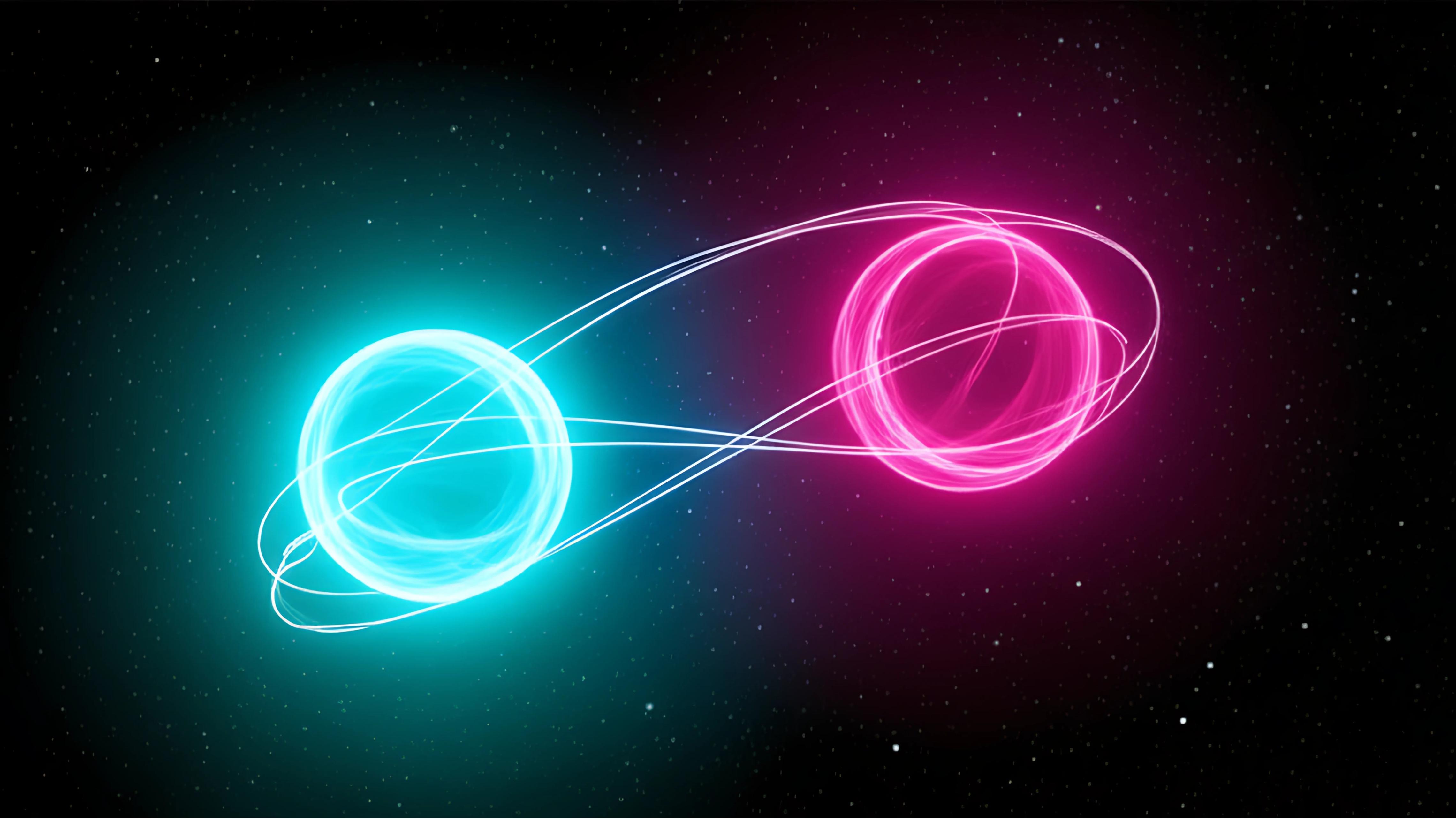
The Quantum Connection
Imagine measuring a particle here on Earth and, in that exact instant, knowing the state of its twin on Mars. It sounds like science fiction, but it's a fundamental reality of our universe known as **quantum entanglement**. Albert Einstein, unsettled by its implications, famously called it **"spooky action at a distance."** This phenomenon, where particles become linked in such a profound way that they behave as a single system regardless of the distance separating them, is not just a theoretical curiosity. It forms the bedrock of emerging technologies like quantum computing, unhackable cryptography, and state-of-the-art sensors. In this post, we'll demystify this "spooky" connection and explore why it continues to fascinate and challenge the brightest minds in physics.
What Exactly is Entanglement?
At its core, entanglement describes a situation where the quantum state of two or more particles cannot be described independently of one another. They are intrinsically linked. Let's use a simple metaphor to grasp this:
Imagine you have a special pair of coins. You give one to a friend, who then travels to the other side of the world. You both agree to flip your coins at the exact same time. When you look at yours and see "heads," you know with 100% certainty that your friend's coin landed on "tails." Every single time.
This is the essence of entanglement. It’s not that the coins had a pre-determined state (like one being secretly marked "heads" all along). Instead, their outcomes were undefined until the moment of measurement, at which point they instantly assumed opposite, correlated states. In the quantum world, this property is often observed with the "spin" of particles like electrons. Spin is an intrinsic form of angular momentum, and for simplicity, can be thought of as being either "spin up" or "spin down." If you have two entangled electrons, measuring one as "spin up" forces the other to instantly become "spin down."
The Physics Behind the Spookiness
To describe this mathematically, physicists use wavefunctions. For a pair of entangled particles (let's call them particle 1 and 2) in a common configuration known as a Bell state, the combined wavefunction looks like this:
This equation tells us that the system is in a **superposition** of two possibilities: either particle 1 is spin-up and particle 2 is spin-down, OR particle 1 is spin-down and particle 2 is spin-up. Both possibilities exist simultaneously. The moment you measure particle 1 and find it is spin-up, the entire system "collapses" into the first state, and you instantly know particle 2 must be spin-down. The key takeaway is that you cannot write a separate, independent state for particle 1 or particle 2—they are described by a single, unified mathematical object.
Why Einstein Called It "Spooky"
In 1935, Albert Einstein, along with his colleagues Boris Podolsky and Nathan Rosen, published the famous **EPR Paradox**. They weren't trying to disprove quantum mechanics, but to argue that it was an *incomplete* theory. Einstein was deeply troubled by two aspects of it: its inherent randomness and its non-locality.
He believed in **local realism**—the idea that objects are only influenced by their immediate surroundings (locality) and that their properties exist definitively before we measure them (realism). Entanglement seemed to violate both. How could a measurement here instantly affect something over there without any signal traveling between them? Einstein suspected there were "hidden variables"—unknown properties of the particles that determined their states from the moment they were created. He famously quipped, **"God does not play dice with the universe,"** expressing his distaste for the probabilistic nature of quantum theory.
Bell's Theorem: The Ultimate Test
For decades, the debate between Einstein's hidden variables and quantum non-locality was purely philosophical. That changed in the 1960s when physicist **John Stewart Bell** devised a brilliant mathematical test. **Bell's Theorem** provided a way to experimentally distinguish between the two theories. He derived an inequality that *must* be satisfied if local hidden variables were real. However, if quantum mechanics was correct, this inequality would be violated.
Countless experiments since the 1970s, most notably by physicists like John Clauser and Alain Aspect, have overwhelmingly shown that Bell's inequality is consistently violated. The universe, it turns out, is just as "spooky" as quantum mechanics predicts. Einstein's classical intuition, powerful as it was, did not hold up in the quantum realm.
Real-World Applications
Entanglement is no longer just a paradox; it's a powerful resource driving the next wave of technology:
- Quantum Computing: Classical computers use bits (0s and 1s). Quantum computers use **qubits**, which can exist in a superposition of both 0 and 1. By entangling qubits, quantum computers can perform massive parallel calculations, promising to solve problems that are impossible for even the most powerful supercomputers today.
- Quantum Cryptography: Entanglement provides a way to create unbreakable communication channels. If two parties share a key made of entangled particles, any attempt by an eavesdropper to intercept and measure the key would instantly break the entanglement, alerting the users to the security breach.
- Quantum Teleportation: While not the stuff of Star Trek, quantum teleportation is real. It involves transferring the exact quantum state of a particle from one location to another without physically moving the particle itself. This process relies on entanglement to transmit the information.
Final Thoughts: Embracing the Weird
Quantum entanglement forces us to abandon our everyday intuitions about how the world works. It shows us a universe that is deeply interconnected, where the concepts of distance and separation are not as clear-cut as they seem. It blurs the line between individual objects and a unified system. As the great physicist Richard Feynman once said, **"If you think you understand quantum mechanics, you don't understand quantum mechanics."** This sentiment perfectly captures the spirit of entanglement—it is a concept that continues to inspire awe and humility. If the universe is this strange and wonderful at its very core, what other marvels are we yet to discover?